Fahrenheit 451 by Ray Bradbury
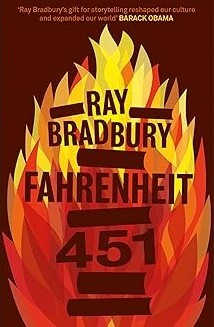
Last year, a friend shared a list of six books with me, which she intended to suggest to her book club. At the time, I didn't have the mental space to pick up any of the books and engage with them meaningfully, so I put the list to one side and promptly forgot about it. That is, until recently when I decided I would read all six books, not least because my friend chose them because she felt the titles, though written a while ago, had something to say about our current times. This is the first of the six on the list.
Ray Bradbury's Fahrenheit 451 is very prescient. It was first published in 1953 and features an unnamed authoritarian city in the future, with modern technology aplenty and where the freedoms of expression and thought are suppressed to the extent of burning all books. In this society, technology has made house fires a thing of the past, but to ensure that firemen are kept in employment, their role is to douse outlawed books and houses with kerosene and burn them at Fahrenheit 451.
This is what the protagonist Guy Montag does for a living, without thinking too much about it, until he has a Damascene conversion by way of 17 year old Clarisse. Clarisse is his neighbour and he meets her late one balmy night on his way home from work. She is portrayed as ethereal and beguiling, in a manner likely to discomfit modern readers (Montag is 30). Clarisse is perhaps the first person who really sees him:
How like a mirror, too, her face. Impossible; for how many people did you know that refracted your own light to you? ...How rarely did other people's faces take of you and throw back to you your own expression, your innermost trembling thought?
What incredible power of identification the girl had; she was like the eager watcher of a marionette show, anticipating each flicker of an eyelid, each gesture of the hand, each flick of a finger, the moment before it began.
The destruction of books is intended to make people placid by ensuring that ideas do not stir the surface of their "peace". They have interactive parlour walls, akin to TVs, to bamboozle them with "families" that talk and talk, all day and night, but little is said of import. This is intended to keep people "happy" and distracted enough that they don't ask the big questions, a fictional detail that presages the numbing effects of social media.
The city's newspapers have long since stopped to exist. The cumulative result of these conditions is a deeply lonely and uninformed populace, where no one has the courage to look the other in the eye and really see them. All Clarisse has to do is be curious and ask a few choice questions, to send Montag on a dangerous path against the censoring, anti-intellectual government, on behalf of which Montag has hitherto been an instrument of oppression. The city hunts university professors and other keepers of books and knowledge as dangerous elements in need of elimination. They live in hiding in fear for their lives.
Women don't feature as intellectual equals, apart from perhaps the 17 year old Clarisse, who serves as a Manic Pixie Dream Girl plot device to awaken the slumbering fireman and boost his ego. Women are depicted as unable to handle complexity and only too happy to escape into the parlour walls.
There is a terrifying robot dog, neither animal nor machine, trained to know every detail about humans and hunt down dissidents, armed with a lethal injection of something called Procaine.
We're living in the time that Ray Bradbury foresaw, where newspapers are in decline, while other mainsream media have lost their hold on societies and we're siloed into our own private feeds, entertained, but without a public square to forge a shared reality. Book censorship is something we still do, and in any event, many of us don't read anyway, because everything is video now.
In the book, Montag asks, "Where do we go from here? Would books help us?" To which Faber, a former English professor and secret preserver of books replies, "Only if the third necessary thing could be given us. Number one, as I said, quality of information. Number two: leisure to digest it. And number three: the right to carry out actions based on what we learn from the interaction of the first two." I see it as a call to action to read more books, make the time to think about them and take informed action.
Fahrenheit 451 was a quick read that was both discomfitting and prophetic. I could almost smell the kerosene. While I was reading it, I listened to a podcast on Joseph Roth whose books were burned by the Nazis and who wrote The Radetzky March, the next book from my friend's reading list. It made Fahrenheit 451 all too real, awful and worth the time, even if they author, to my reading, thinks little of women.
⚘